What is corrosion under insulation (CUI)?
·Updated ·11 sources
Corrosion under insulation (CUI) is corrosion of insulated pipes, vessels and tanks where water, leaking in through damaged cladding or condensing underneath, is held against the steel. Out of sight under the jacket, wall loss on carbon steel or chloride cracking on stainless steel can go undetected unless someone inspects for it, and leaks can follow.
By Jiakai Yang, Editor, with Beacon's AI newsroom·Checked
Why does it matter?
At an ethylene plant at Mossmorran in Fife, Scotland, five leaks of extremely flammable hydrocarbons between February 2018 and September 2019 were all attributed to corrosion under insulation, the UK Health and Safety Executive (HSE) reported when the operator was fined £267,000 in August 2026 7. One leak ran for about six weeks and released an estimated 82 tonnes of hydrocarbons 7. Another came to light when HSE inspectors smelled gas on a routine visit in May 2019; the company had known about it for around four months and kept operating 7. HSE found that overhead pipes had often been checked by eye from the ground, sometimes several metres away, and that insulation was not always removed 7.
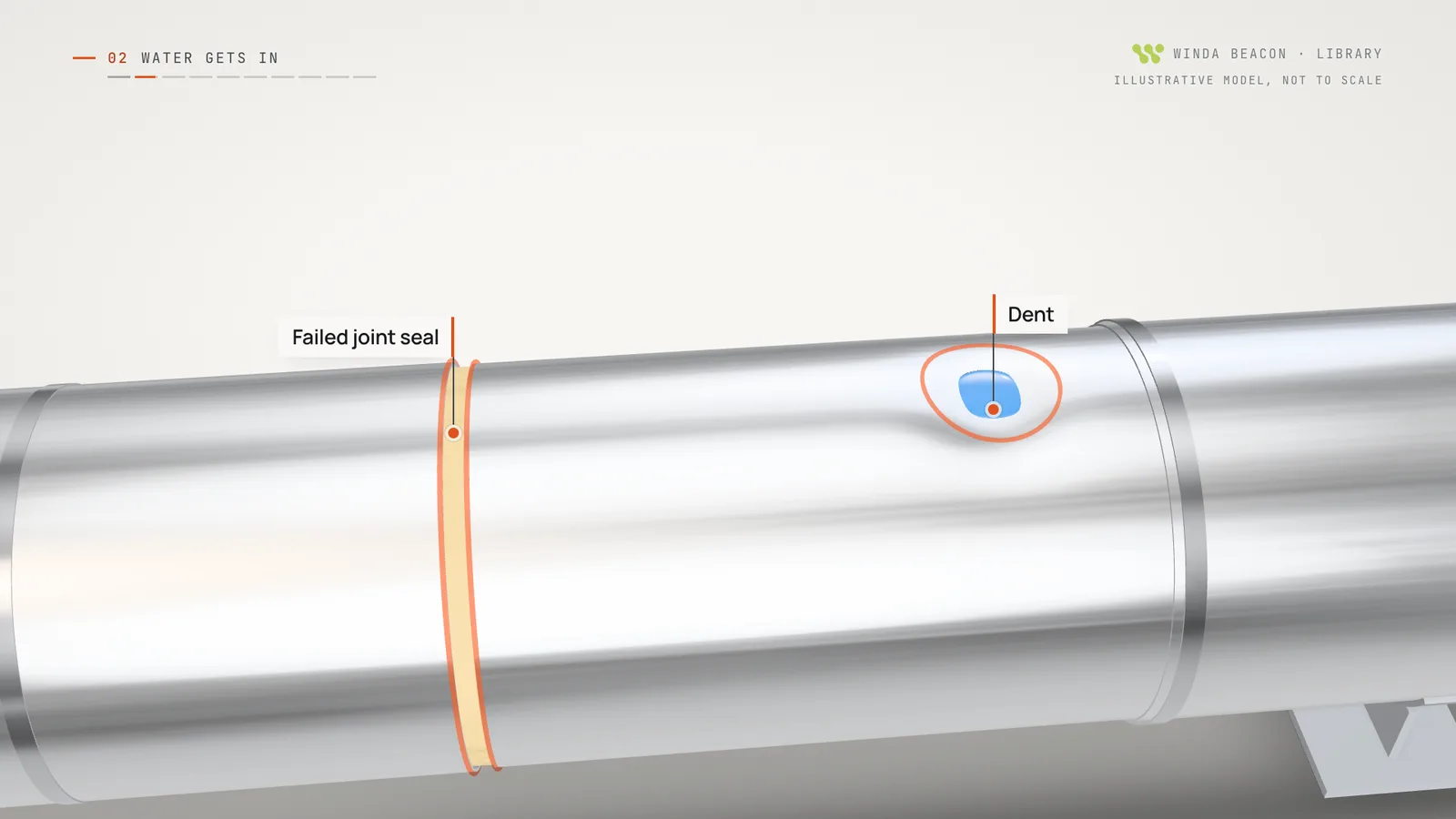
Step 1: how does water get in?
Water reaches insulated steel from rain, cooling towers, sprinkler systems and condensation, so it does not always need a gap in the cladding 4. Where it does leak in, the 2011 HSE circular for its inspectors listed four usual routes: cladding badly designed or fitted, joint sealant that has broken down, mechanical damage, and cladding taken off and not properly put back, common around valve boxes 3.
The problem grew with insulation itself. Until the 1970s, insulation went mainly on lines hotter than about 150 °C, where moisture boiled off; during that decade's energy shortage, cooler lines began to be insulated to save energy, and water stayed in the insulation 4.
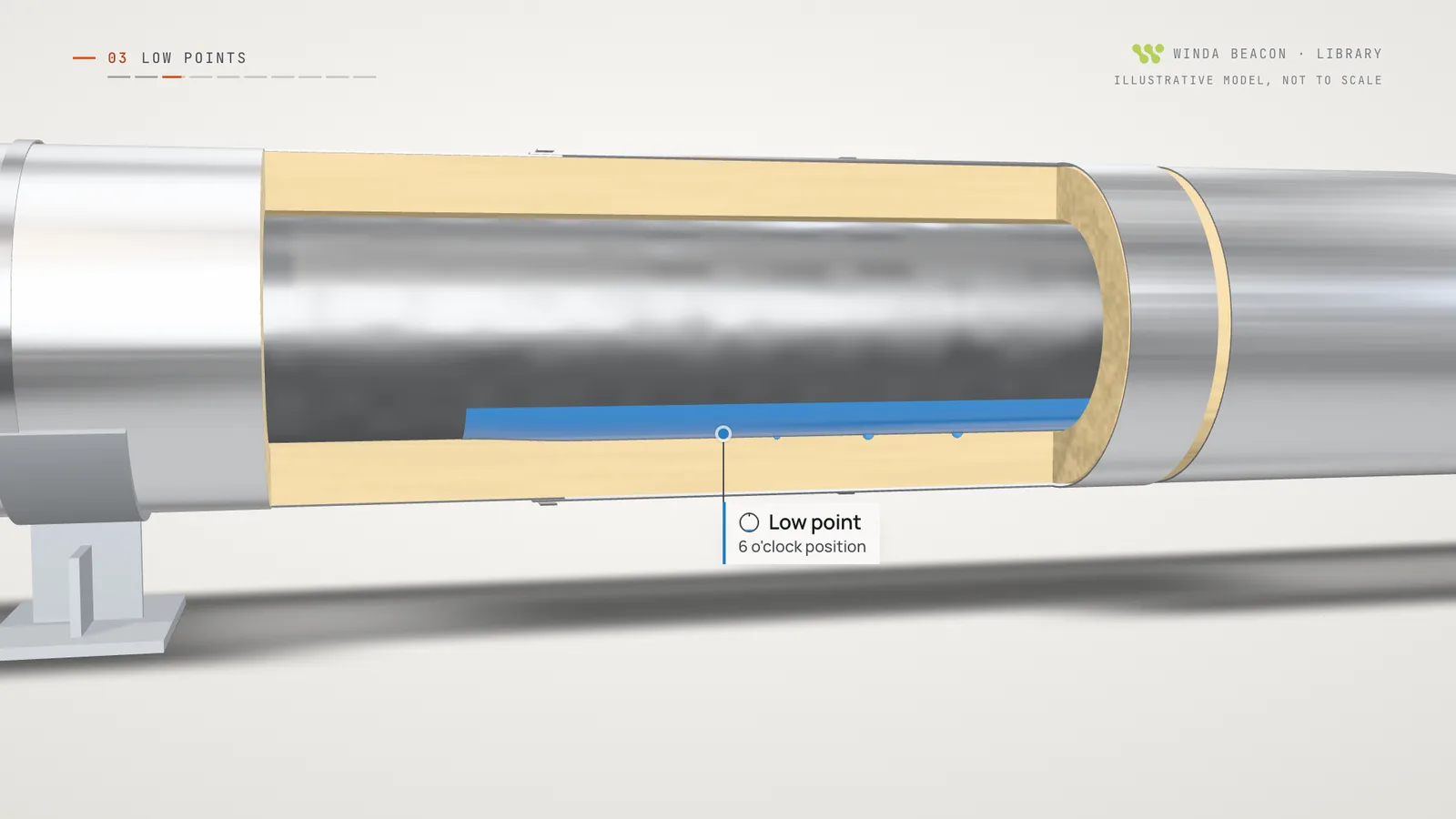
Step 2: why does the damage gather at low points?
Once inside, water runs down and collects at low points and discontinuities: vessel bases, pipe supports, where nozzles meet vessels, the underside of elbows and horizontal runs, and drain legs 3. In the field, damage is often found at the 6 o'clock position of a pipe, though not only there 4.
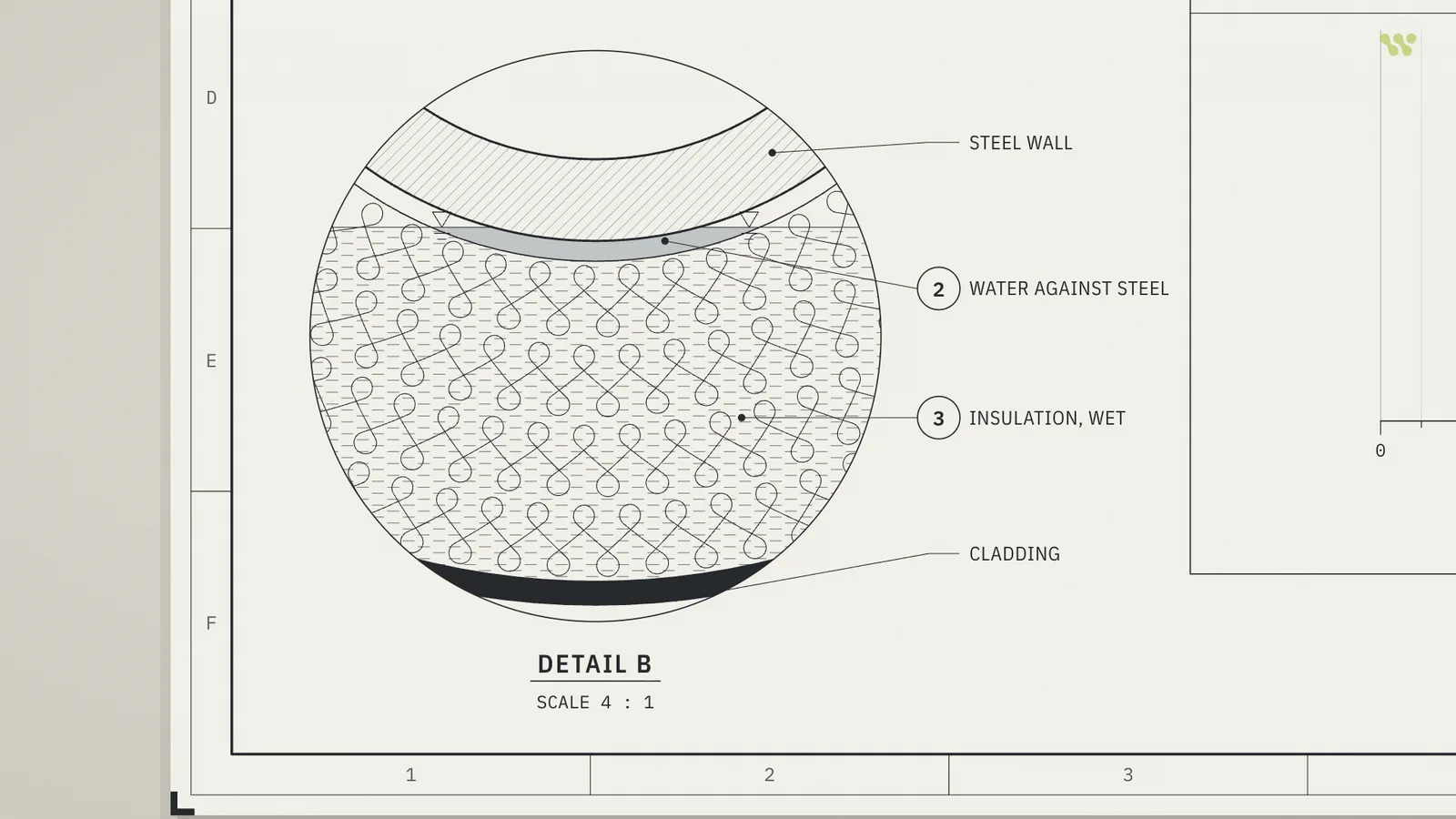
Step 3: how does insulation keep the steel wet?
Steel corrodes when it meets water with a supply of oxygen, and insulation usually leaves a narrow space against the metal where water can sit with access to air 3. Fibrous mineral wool, fibreglass and calcium silicate soak up water easily, while closed-cell foam glass and perlite take up less, as a class 3.
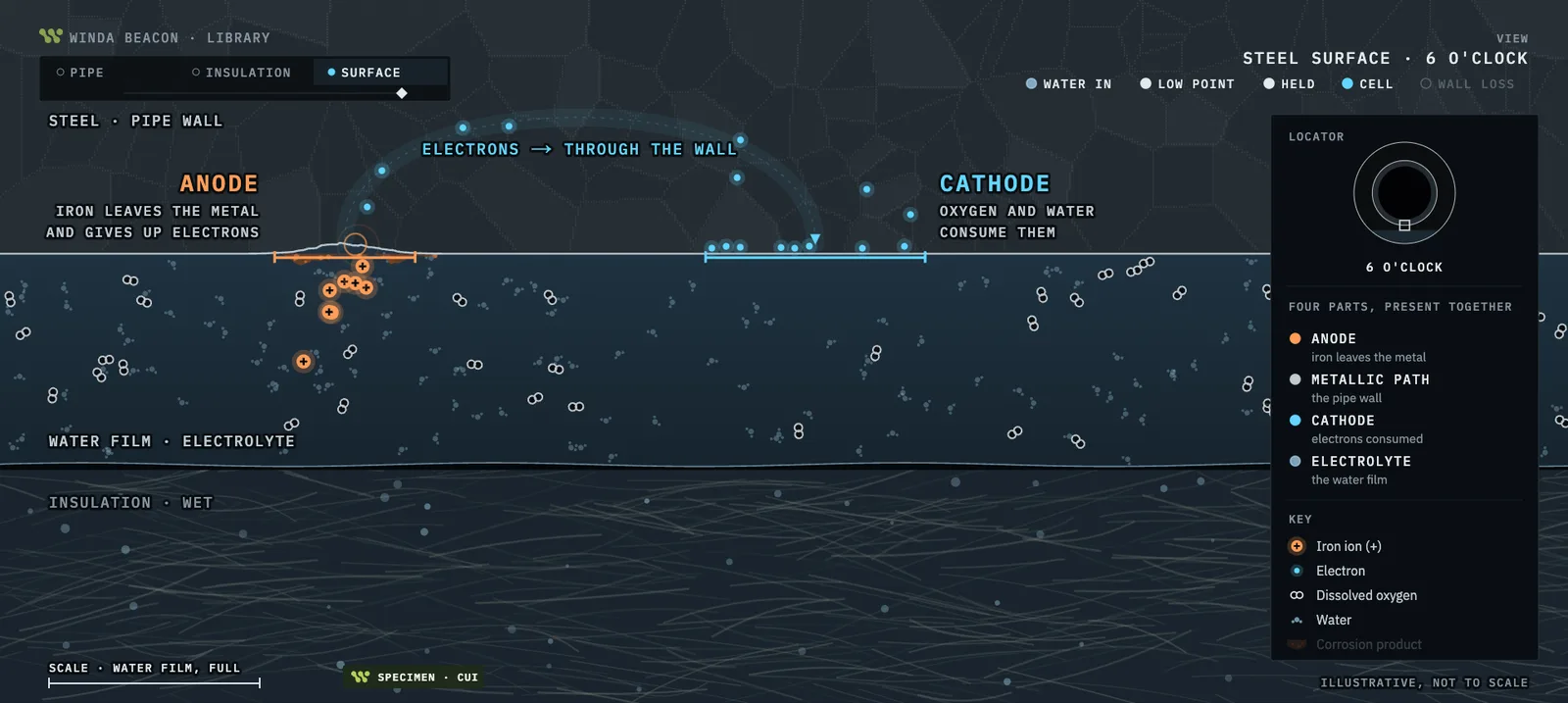
The attack is electrochemical. NASA's corrosion laboratory explains that wherever a material in contact with metal holds moisture against it, corrosion concentrates where oxygen is scarcest, which becomes the anode, and it advises against materials that wick moisture onto the surface 10.
Wet insulation is a material of that kind, so differences in oxygen access under it can concentrate the attack in places. Where the insulation is wet more evenly, CUI can also be general rather than localized.
A 2022 review notes that at high moisture contents, water spreads more evenly through the insulation and corrosion is more generally distributed 4.
Step 4: which temperatures carry the most risk?
A historical public table comes from the 2011 HSE circular, which is now only available as an archived copy and should be read as the experience of its time 3. For carbon steel pipework without trace heating, it rated the likely CUI risk by operating temperature, by whether the pipework was painted and more or less than ten years old, and by whether the line runs continuously or intermittently 3. It treated trace heating itself as a high risk factor 3.
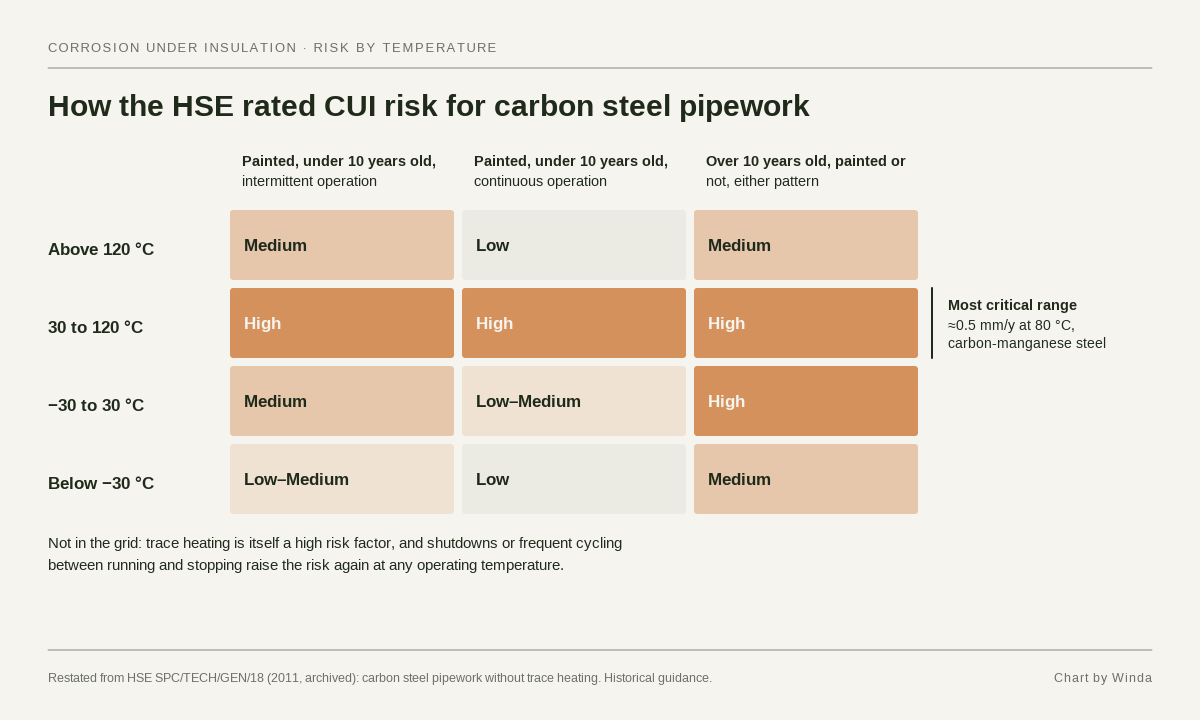
Three things stand out in that table 3:
- 30 to 120 °C is high risk in every column. The circular called it the most critical range, and cited US data for carbon-manganese steel of about 0.5 mm per year (mm/y) at 80 °C under insulation 3.
- Old pipework is at risk even when cold. Pipework more than ten years old was rated high risk from −30 to 30 °C, and medium below −30 °C 3.
- Hot lines are not safe. Above 120 °C moisture should evaporate at start-up, but the circular warned that shutdowns and frequent cycling between running and stopping raise the risk again 3.
Field rates can be higher. A 2022 review reports one case of about 1 mm/y between 60 and 120 °C 4.
What does CUI do to carbon and stainless steel?
API RP 583, Corrosion Under Insulation and Fireproofing, deals with two kinds of damage, by API's own summary: wall loss on the outside of carbon and low-alloy steel, whether under insulation or fireproofing, and, on insulated austenitic and duplex stainless steel, cracking driven by chlorides from outside, known as external chloride stress corrosion cracking (ECSCC) 1. Its third edition was published in April 2026 2.
On carbon steel the attack can be even or localized; on stainless steel it is mostly pitting and stress corrosion cracking, and duplex grades, with 20 to 28 percent chromium, resist it better without being immune 4. Stress corrosion cracking needs a tensile stress, which can be residual from manufacture, as well as a corrosive environment 10. The chlorides can come from the cladding itself, from coastal and offshore air, or be leached out of wet insulation onto hot stainless steel 3 10. The HSE circular said chloride cracking should be considered on austenitic stainless steel from 65 °C, and that high-carbon stainless grades could suffer intergranular attack and chloride cracking from 50 °C 3.
Step 5: how is CUI found?
The methods do four different jobs, and it helps to keep them apart 3 5:
| Job | Method | What it gives | What to keep in mind |
|---|---|---|---|
| Find wet insulation | Infrared thermography | Wet or damaged insulation 3 | Not the corrosion itself; drying cycles on hot lines can mislead it, and a dry reading does not prove the steel is sound 3 |
| Find wet insulation | Neutron backscatter | Wet insulation, at around 300 m of pipe a day in the circular's time 3 | Finds water, not wall loss 3 |
| Screen for damage | Guided wave ultrasonics | Can locate defects along the pipe from one position, typically 5 to 100 m in each direction depending on its condition, coating and features 5 | Insulation comes off only where the transducer sits; it gives a rough idea of severity, and a follow-up inspection at that spot sizes the wall loss 5 |
| Measure the steel | Pulsed eddy current (PEC) | Remaining wall in ferritic steel, through the insulation 3 | Averages over the sensor's footprint, so small pits may be missed or understated; insulation type and thickness limit it 3 4 |
| Measure the steel | Profile and real-time radiography | An image of the wall through the insulation 3 4 | Radiation work: HSE ruled out an unshielded hand-held variant of flash radiography because it exposed operators 3 |
| See the steel | Inspection windows | The actual surface where a window is cut 3 | Only as good as where the windows go; for critical lines where no leak is acceptable, full removal may be required 3 |
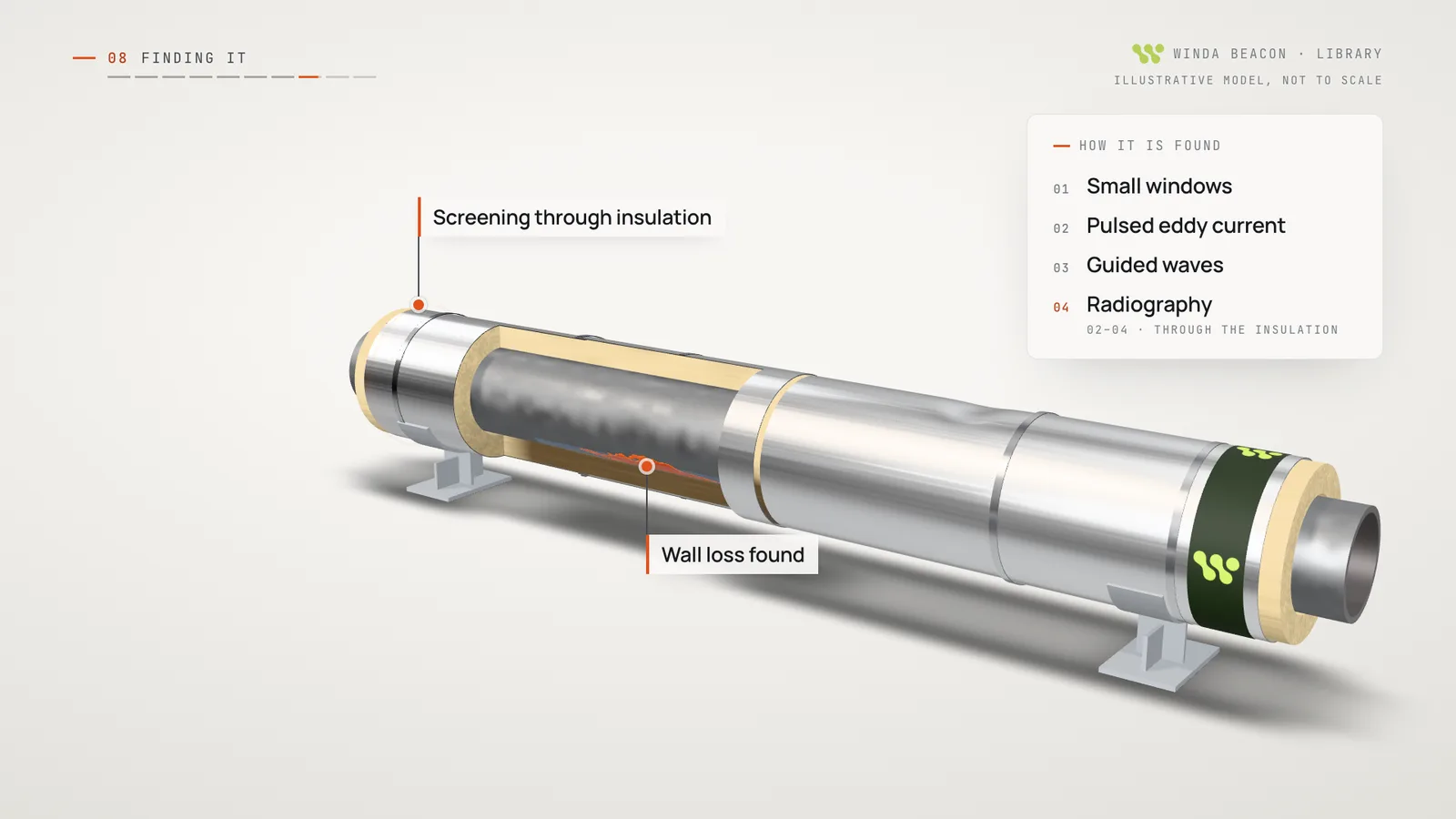
Whatever the method, it has to match the damage expected: every technique has strengths and weaknesses for particular damage mechanisms, and stress corrosion cracks are planar flaws that a wall-thickness reading does not show 11. On insulated stainless steel, a sound thickness result does not rule out cracking 11 1.
Moisture can trigger the next step. One study of a plant in service for 40 years, reviewed in 2022, found severe CUI, deeper than 1 mm, once insulation moisture passed 25 percent by volume, and advised inspection above 15 percent; its thresholds come from that plant, not from a general rule 4.
Where to look first
The sources point to the same places again and again. Read together, they give a screening list for an insulated line; the temperatures in it are historical observations from the 2011 HSE circular, not cut-offs below or above which a line is safe 3 4 7:
- Temperature. Carbon steel between 30 and 120 °C, which the circular called the most critical range, and older pipework at lower temperatures too 3.
- Cycling and trace heating. Lines that shut down often, or carry trace heating 3.
- Low points. The underside of horizontal runs and elbows, vessel bases, and the 6 o'clock position 3 4.
- Discontinuities. Pipe supports, nozzles and drain legs 3.
- Recent maintenance. Valve boxes and any cladding taken off and put back 3.
- Damaged jacketing. Dents and failed joint sealant 3.
- Wet surroundings. Lines near sprinkler systems and cooling towers 4.
- Absorbent insulation. Mineral wool, fibreglass and calcium silicate 3.
- Stainless steel with chlorides. Coastal and offshore sites, from about 65 °C for austenitic grades and 50 °C for high-carbon grades 3.
- Overhead lines seen only from the ground. The pattern behind the Mossmorran leaks 7.
How is CUI prevented?
The HSE circular's preventive measures start before insulation goes on: insulate only where it is needed, and where it is only there to protect people from hot surfaces, consider guards instead 3. Where insulation is needed, it favoured materials that hold less water, insulation held clear of the steel, details that keep water out at cut-outs for valves and equipment, and insulation that is easy to remove and put back for inspection 3. It also stressed coatings suited to the operating temperature and properly applied, naming thermally sprayed aluminium as offering superior protection on carbon and low-alloy steel when well applied 3.
Upkeep matters as much as design. The circular asked for prompt reporting and repair of damaged insulation, for insulation to be restored to its original specification or better after any work, and for CUI to be part of the planned maintenance schedule 3. NASA's corrosion laboratory makes the same point for stainless steam and condensate lines: keep the jackets intact so moisture does not get into the insulation, or is quickly drained off when it does 10.
What happened when it was missed
Three published cases show the same thing from different angles 7 6 10:
| Case | What was under the insulation | How it came to light |
|---|---|---|
| Mossmorran ethylene plant, Fife, February 2018 | A pinhole leak on a 2-inch line under high pressure, running at 115 °C 7 | Leak, fixed after around four months 7 |
| Mossmorran, June 2019 | The inlet line to the acetylene converter, corroded below its safe minimum thickness 7 | A pinhole leak found by a process technician; X-ray testing confirmed the thinning 7 |
| Offshore platform regulated by BSEE, 2018 | Diesel generator exhaust piping corroded through, in places separated completely, under insulation blankets 6 | Found while investigating a fire in the generator enclosure, whose cause was inconclusive; an identical generator shut down on the regulator's instruction had the same damage at the same points 6 |
| An insulated stainless condensate line (NASA's example) | Stress corrosion cracking from chlorides leached out of wet insulation onto the hot metal 10 | NASA uses it to illustrate a common problem on steam and condensate lines 10 |
After its case, the US Bureau of Safety and Environmental Enforcement (BSEE) recommended routine inspection of all insulated components, even where guards and insulation have to be removed to reach them 6. US federal rules for gas and hazardous liquid pipelines require operators to give particular attention to pipe under thermal insulation during atmospheric corrosion inspections 8 9. For pipelines subject to 49 CFR Parts 192 and 195, those inspections are due at least once every 3 calendar years onshore, at intervals of no more than 39 months, and at least once each calendar year offshore, at intervals of no more than 15 months 8 9. Onshore gas service lines are inspected at least once every 5 calendar years, at intervals of no more than 63 months, and within 3 calendar years (39 months) after an inspection that found atmospheric corrosion 8.
How CUI connects
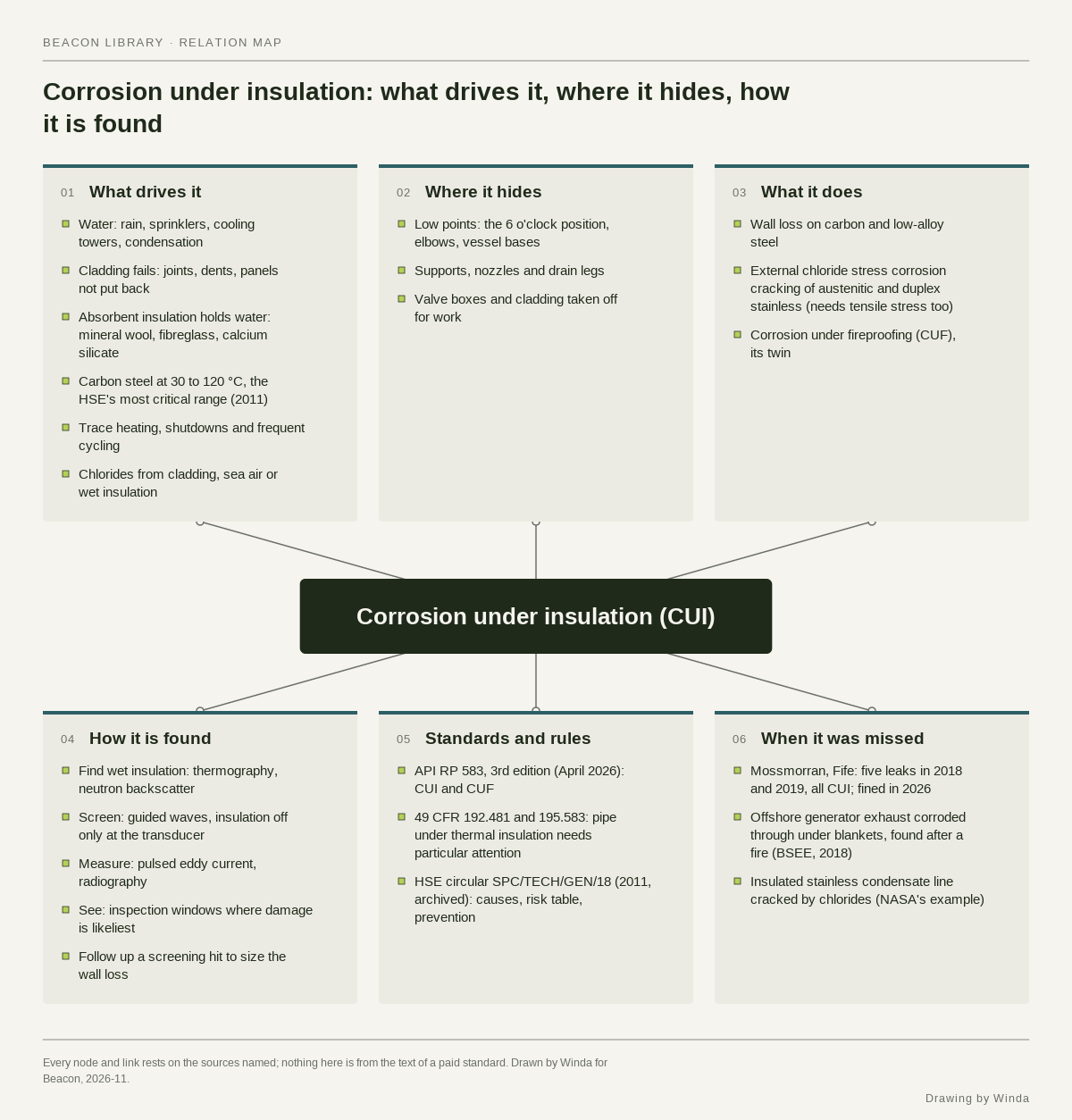
The map gathers this page in one view: what drives CUI, where it hides, what it does, how it is found, the rules that name it, and the cases where it was missed 3 4 1.
Is CUI the same as atmospheric corrosion?
Not quite. Both attack the outside of equipment, and US pipeline rules even inspect insulated pipe as part of atmospheric corrosion monitoring 8. What sets CUI apart is the insulation: it holds water against the metal and hides the result, so the damage is not directly visible without removing the jacket or inspecting through it 4.
Common questions
- Which temperatures carry the highest CUI risk?
- A 2011 UK Health and Safety Executive circular, now only in archived form, named 30 to 120 °C as the most critical range for carbon steel pipework without trace heating, and rated pipework more than ten years old at high risk from −30 to 120 °C. Shutdowns and frequent cycling raise the risk at any operating temperature.
- Can stainless steel suffer CUI?
- Yes, mostly as external chloride stress corrosion cracking of austenitic grades, which needs chlorides, a tensile stress and heat. The same HSE circular said it should be considered from 65 °C, and that high-carbon stainless grades could be attacked from 50 °C.
- Does thermography find corrosion under insulation?
- No. Infrared thermography and neutron backscatter find wet or damaged insulation, which tells inspectors where to look. Wall loss is measured through the insulation with pulsed eddy current or radiography, screened with guided waves, or seen directly in windows cut into the insulation.
Beacon explains these concepts in its own words for education. It does not reproduce or replace the standards cited, and Winda is not affiliated with or endorsed by the organizations that publish them. Engineering decisions need the current edition of the standard and a qualified engineer.
Sources
- 1.2025 Publications Catalog, entry for RP 583, Corrosion Under Insulation and Fireproofing (scope as API describes it) · American Petroleum Institute (API)
- 2.API Standards Plan: Industry Standards in Development (RP 583, 3rd edition, published 22 April 2026) · American Petroleum Institute (API)
- 3.Corrosion under insulation of plant and pipework, semi-permanent circular SPC/TECH/GEN/18, issued 1 March 2011, review date 28 February 2013 (archived copy; the live page no longer exists) · UK Health and Safety Executive ·
- 4.Cao, Pojtanabuntoeng, Esmaily, Thomas, Brameld, Amer and Birbilis, A Review of Corrosion under Insulation: A Critical Issue in the Oil and Gas Industry, Metals 12(4), 561, 2022 · Metals (MDPI), via MIT DSpace ·
- 5.Cawley, Guided waves in long range nondestructive testing and structural health monitoring: principles, history of applications and prospects, NDT & E International 142, 103026, 2024 · NDT & E International (open access, CC BY 4.0) ·
- 6.Safety Bulletin No. 013: Severe Corrosion Found Under Insulation · Bureau of Safety and Environmental Enforcement ·
- 7.Six-figure fine for ExxonMobil after five leaks of extremely flammable hydrocarbons at Fife chemical plant (press release) · UK Health and Safety Executive (HSE) ·
- 8.49 CFR 192.481, Atmospheric corrosion control: Monitoring · eCFR, US Office of the Federal Register
- 9.49 CFR 195.583, What must I do to monitor atmospheric corrosion control? · eCFR, US Office of the Federal Register
- 10.Forms of Corrosion · NASA Kennedy Space Center, Corrosion Engineering Laboratory
- 11.Technical measures document: Inspection / Non Destructive Testing (COMAH guidance) · UK Health and Safety Executive (HSE)